
In modern veterinary hospitals, patient care is divided into different levels depending on the severity of the condition. Two of the most important care areas are the Veterinary Intensive Care Unit (ICU) and the General Ward. Although both support animal recovery, they serve very different clinical purposes.
Understanding these differences is essential for veterinary clinics and hospital planners who want to improve survival rates, optimize workflows, and choose the right medical equipment.
This article explains the key differences between ICU and general ward systems—and how modern ICU infrastructure such as integrated ICU cabin systems can significantly improve critical care outcomes.
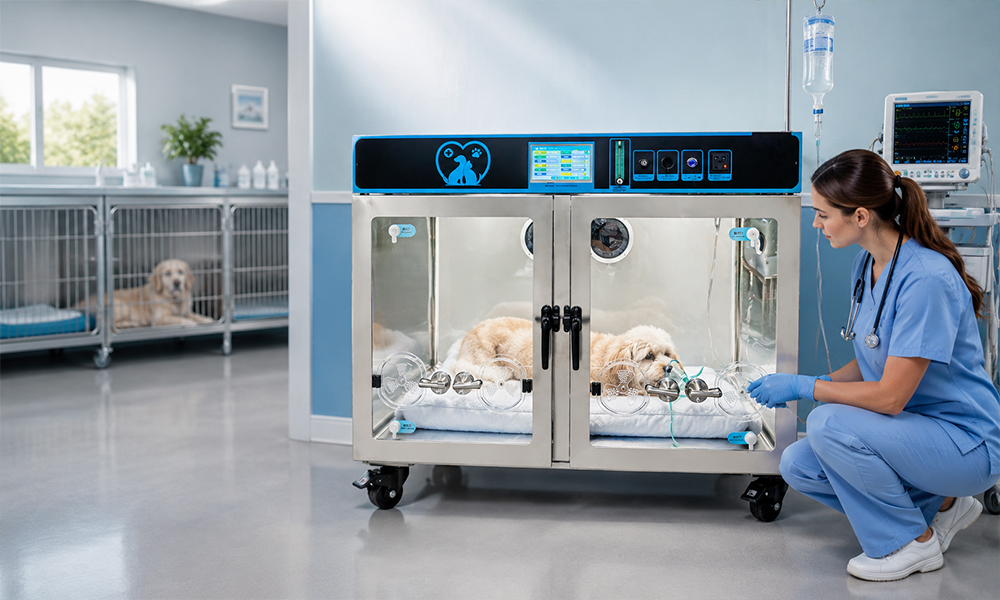
What Is a Veterinary ICU?
A Veterinary ICU is a specialized treatment area designed for critically ill or unstable patients requiring continuous monitoring and life-support care.
Typical ICU cases include:
-
- Post-surgical unstable patients
- Severe respiratory distress
- Trauma or emergency cases
- Organ failure or critical infections
The ICU is designed to maintain vital functions through oxygen support, controlled environments, and real-time monitoring systems.
What Is a Veterinary General Ward?
A General Ward is designed for stable or recovering patients who do not require intensive monitoring.
Common cases include:
- Mild illness recovery
- Post-operative stable animals
- Routine treatment and observation
Unlike ICU environments, general wards rely on periodic checks rather than continuous monitoring.
Key Differences Between ICU and General Ward
The difference between ICU and general ward lies in the level of care and technological support.
1. Patient Condition: ICU handles critical cases, while wards handle stable recovery.
2. Monitoring: ICU requires continuous monitoring; wards use scheduled checks.
3. Equipment: ICU includes oxygen systems, monitoring devices, and infusion pumps.
4. Environment: ICU requires controlled temperature, humidity, and oxygen levels.
5. Staff Intensity: ICU requires a higher staff-to-patient ratio.
Equipment Differences: ICU vs General Ward
The equipment used in ICU environments is significantly more advanced than in general wards.
ICU Equipment Includes:
- ICU cage systems with oxygen control
- Temperature and humidity regulation systems
- Multi-parameter monitoring systems
- Infusion and life-support devices
General Ward Equipment Includes:
- Standard cages
- Basic bedding and observation tools
Among all ICU equipment, the ICU cage system plays one of the most important roles because it directly affects oxygen delivery, temperature stability, and patient stress levels.
Why ICU Environment Design Is Critical
ICU performance is not only about medical devices—it also depends on environmental design.
Key ICU environmental requirements include:
- Stable oxygen concentration
- Controlled temperature and humidity
- Reduced noise and stress
- Infection control and isolation capability
Without a properly designed ICU environment, even advanced medical treatment may not achieve optimal results.
Modern ICU Solutions: Integrated ICU Cabin Systems
To meet the growing demands of veterinary critical care, many clinics are now upgrading to integrated ICU cabin systems that combine oxygen control, temperature regulation, and isolation into one unit.
One example is the OliveVet Veterinary ICU Cabin VET-V202, designed for modern animal hospitals requiring advanced critical care infrastructure.
This system integrates multiple functions into a single ICU environment, including:
- Oxygen control system
- Temperature and humidity regulation
- UV sterilization and air purification
- Multi-compartment ICU design for flexible use
You can view the product here:
Such systems are particularly useful for clinics that want to upgrade from basic ICU cages to a more controlled and efficient critical care environment.
When Should a Patient Be Transferred to ICU?
Patients should be moved to ICU when they require intensive monitoring or life-support intervention.
Common indicators include:
- Difficulty breathing
- Post-surgical instability
- Severe trauma or shock
- Continuous oxygen support requirement
Early ICU admission improves survival chances significantly.
How ICU Systems Improve Survival Rates
Modern ICU systems improve outcomes through:
- Continuous oxygen therapy
- Stable controlled environments
- Real-time monitoring capabilities
- Reduced stress and infection risks
Integrated ICU cabin systems further enhance efficiency by combining these functions into one controlled environment.
Choosing the Right ICU System for Veterinary Clinics
For veterinary hospitals and distributors, selecting the right ICU system is a critical investment decision.
Important factors include:
- Oxygen control accuracy
- Material durability and safety
- Cleaning and sterilization efficiency
- Environmental control stability
- OEM/ODM customization capability
Advanced ICU cabin systems such as VET-V202 are designed to meet these clinical and operational requirements.
Conclusion
The difference between a veterinary ICU and a general ward goes far beyond layout—it reflects the level of care a patient receives.
While general wards support stable recovery, ICUs are designed for life-saving interventions that require precise environmental and medical control.
For clinics aiming to upgrade their critical care capabilities, integrated ICU cabin systems like the OliveVet VET-V202 offer a more advanced and efficient solution compared to traditional setups.
FAQ
What is the main purpose of a veterinary ICU?
To provide continuous monitoring and life-support care for critically ill animals.
Can all patients be treated in a general ward?
No, only stable or recovering patients are suitable for general wards.
What is an ICU cabin system?
It is an integrated unit combining oxygen control, environmental regulation, and isolation functions for critical care.
How does an ICU cage help recovery?
It provides controlled oxygen, stable environment, and reduced stress for patients.
When should a pet be moved to ICU care?
When the patient is unstable, requires oxygen support, or continuous monitoring.