
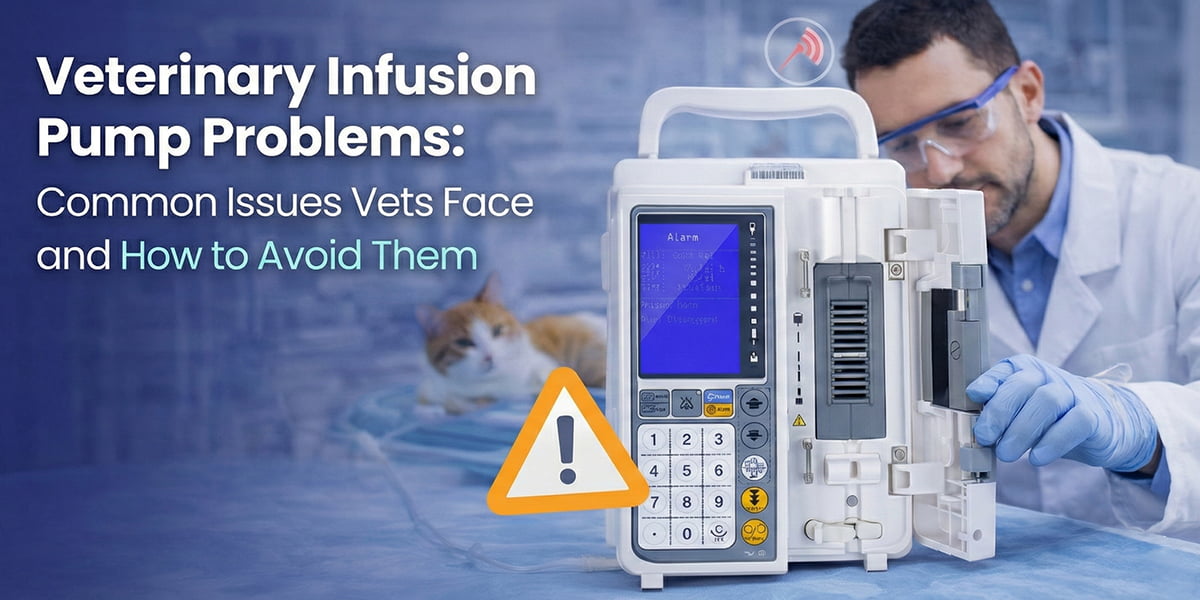
 Veterinary Infusion Pump Problems are usually not something vets search for until something breaks, alarms won’t stop, or the infusion just doesn’t feel right.
Is the flow rate drifting again.
Why is the alarm screaming when nothing is blocked.
Why does starting an infusion feel harder than the procedure itself.
I hear these questions all the time.
Usually over coffee.
Usually after a long shift.
Let’s talk about the real Veterinary Infusion Pump Problems, why they happen, and how to avoid them without adding complexity to your clinic.
Why Veterinary Infusion Pump Problems Matter in Daily Practice
This isn’t about specs on a brochure.
This is about what happens on a normal workday.
When an infusion pump doesn’t behave, it leads to:
- Treatment delays
- Staff frustration
- Higher clinical risk, especially for small animals
- Loss of trust in the equipment
Most vets don’t want advanced features.
They want reliability.
Problem 1: Unstable Fluid Delivery
This is usually the first issue vets notice.
The pump says it’s delivering steadily.
The patient says otherwise.
Common signs include:
- Drip rate doesn’t match the setting
- Flow changes during infusion
- Small animals reacting to over- or under-infusion
This is one of the most frequent Veterinary Infusion Pump Problems, especially in clinics treating cats, puppies, or ICU cases.
Why it happens:
- Poor low-flow accuracy
- Inconsistent motor control
- Limited tubing compatibility
How to avoid it:
Prioritise stability over extra features.
Choose infusion pumps designed specifically for veterinary fluid therapy.
Purpose-built models such as the
VET-IP01 Veterinary Infusion Pump
focus on consistent delivery under real clinic conditions.
Problem 2: False or Over-Sensitive Alarms
Alarms are meant to protect patients.
Until they become background noise.
Common complaints include:
- Alarms triggering without blockage
- Repeated alerts during procedures
- Staff muting alarms out of habit
That last one is where risk starts.
Why this happens:
- Over-sensitive pressure detection
- Poor alarm calibration
- Alarm logic not suited to veterinary workflows
How to avoid it:
A reliable veterinary infusion pump should offer:
- Clear and logical alarm thresholds
- Different alerts for different situations
- Easy adjustment without confusion
Problem 3: Complicated Operation
If a pump needs a manual every time, that’s a problem.
In daily practice, this looks like:
- Too many menus
- Unnecessary parameter settings
- Long training time for new staff
This is a hidden Veterinary Infusion Pump Problem that rarely appears on spec sheets.
How to avoid it:
- Clear screen layout
- Minimal steps to start infusion
- Controls that make sense at a glance
Simple design reduces errors.
Every time.
Problem 4: Cleaning and Maintenance Challenges
No one buys an infusion pump thinking about cleaning.
Until they have to do it every day.
Common issues include:
- Hard-to-clean corners
- Awkward tubing removal
- Concerns about contamination
Why this matters:
- Higher infection risk
- More downtime
- Reduced long-term accuracy
How to avoid it:
- Smooth, wipeable surfaces
- Easy-access tubing paths
- Clear maintenance routines
Choosing the Right Pump to Reduce Veterinary Infusion Pump Problems
If you want fewer problems, ask better questions.
Focus on:
- Stable fluid delivery
- Reliable alarm logic
- Simple operation
- Easy cleaning and maintenance
This is why many clinics choose pumps like the
VET-IP01 Veterinary Infusion Pump
for long-term daily use.
FAQs About Veterinary Infusion Pump Problems
Why do infusion pumps struggle with small animals?
Small animals require precise low-flow delivery, which many non-veterinary pumps can’t maintain consistently.
Can human infusion pumps be used in veterinary clinics?
They can, but they often cause veterinary infusion pump problems due to different tubing and workflow requirements.
How often should infusion pumps be maintained?
Regular cleaning after use and scheduled checks help maintain safety and accuracy.
What is the most overlooked issue?
Ease of use. Complex operation increases errors and delays.
Final Thoughts
Most Veterinary Infusion Pump Problems aren’t caused by poor technique.
They come from using equipment not designed for real veterinary workflows.
Focus on stability.
Clarity.
Ease of use.
That’s how you prevent Veterinary Infusion Pump Problems before they start.