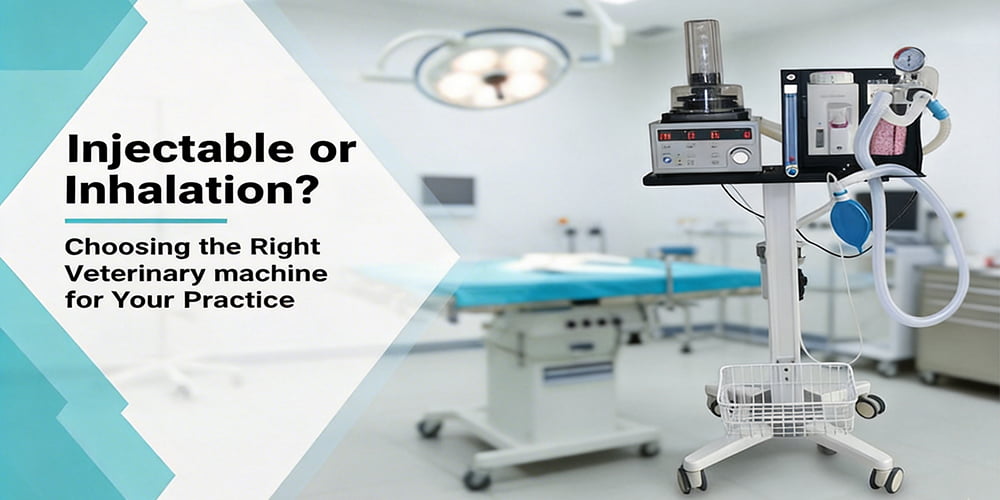
Veterinary Anesthesia Machine decisions usually start with one simple question.Are we still fine with injectables.
Or is it time to upgrade.
If you run a clinic, you’ve probably asked yourself:
- Are longer surgeries becoming more common?
- Are recoveries taking too long?
- Do I feel fully in control of anaesthetic depth?
- Is my current setup limiting what we can offer?
That’s not theory.
That’s daily pressure.
And this is where the choice between injectable and inhalation anaesthesia stops being clinical and starts being operational.
Injectable Anaesthesia: Simple, But Limited
I’ve seen plenty of smaller practices rely heavily on injectables.
It works.
It’s familiar.
It keeps equipment costs down.
Why clinics like it:
- Lower initial investment
- Minimal equipment required
- Straightforward protocols
But here’s the catch.
Once it’s administered, control is limited.
If depth needs adjusting, you’re managing the side effects, not fine-tuning delivery.
For short procedures, that may be acceptable.
For longer or more complex surgeries, it can feel restrictive.
Inhalation Anaesthesia: More Control, More Responsibility
Inhalation anaesthesia gives you something injectables can’t.
Control.
You adjust depth in real time.
Recovery is typically smoother.
For longer procedures, that matters.
But here’s the reality.
Inhalation only works as well as the veterinary anesthesia machine delivering it.
- Gas delivery must be stable
- Oxygen flow must be precise
- Vaporisers must be compatible
If the equipment isn’t solid, the method doesn’t save you.
Why More Clinics Are Moving to Inhalation Systems
This isn’t hype.
It’s volume and expectations.
- More surgeries
- More advanced procedures
- Higher client expectations
- Stronger focus on safety
Modern veterinary anesthesia machines integrate better with ventilators and monitoring systems.
It’s not just about gas.
It’s about workflow.
Signs It Might Be Time to Upgrade
Be honest with yourself.
- Is oxygen flow inconsistent?
- Are repairs becoming frequent?
- Does your machine support only one vaporiser?
- Is maintenance difficult?
- Are you increasing surgical volume?
If even two of these apply, it’s worth reviewing your setup.
A veterinary anesthesia machine should support your growth, not slow you down.
What to Look for in a Veterinary Anesthesia Machine
No fluff. Just essentials.
- Stable oxygen flowmeter – precise and easy to adjust
- Vaporiser compatibility – Isoflurane and Sevoflurane support
- Safety systems – pressure relief valves and alarms
- Ventilator integration – for longer or complex procedures
- Easy maintenance – reduced downtime
- Durable structure – long-term reliability
If you’re reviewing configurations, explore available models here:
Veterinary Anesthesia Machine Models
Compare specifications.
Check compatibility.
Match the system to your surgical demand.
Investment vs Long-Term Value
Injectables seem cheaper upfront.
Inhalation systems cost more initially.
But think beyond purchase price.
A reliable veterinary anesthesia machine can:
- Improve surgical efficiency
- Reduce anaesthetic risk
- Support higher case loads
- Increase client confidence
This isn’t a short-term purchase.
It’s core surgical infrastructure.
FAQs
Is inhalation anaesthesia safer than injectable?
It allows better depth control, especially in longer procedures. Safety depends heavily on equipment quality and monitoring.
Do small clinics need a veterinary anesthesia machine?
If you perform regular surgeries, inhalation systems improve flexibility and recovery control.
How long does a veterinary anesthesia machine last?
With proper maintenance, high-quality systems can operate reliably for many years.
Do I need a ventilator?
For complex or longer surgeries, ventilator integration enhances respiratory support.
What should I check before purchasing?
- Flow accuracy
- Vaporiser compatibility
- Safety mechanisms
- Maintenance access
- After-sales support
Final Thoughts
Choosing between injectable and inhalation is a clinical decision.
Choosing the right Veterinary Anesthesia Machine is a strategic one.
If your clinic is growing.
If surgeries are becoming more advanced.
If safety and efficiency matter.
Review your options carefully.
Explore configurations and technical details here:
Veterinary Anesthesia Machine
The right Veterinary Anesthesia Machine supports not just anaesthesia, but the future of your practice.