
Choosing an anesthesia machine feels overwhelming. A wrong choice can risk patient safety and waste money. Let's break down the options to find your clinic's perfect fit.
The right choice depends on your patient size, case complexity, and clinic space. Compact machines are great for smaller animals and routine procedures. Full workstations offer advanced features for diverse patient sizes and complex surgeries, providing a complete solution.
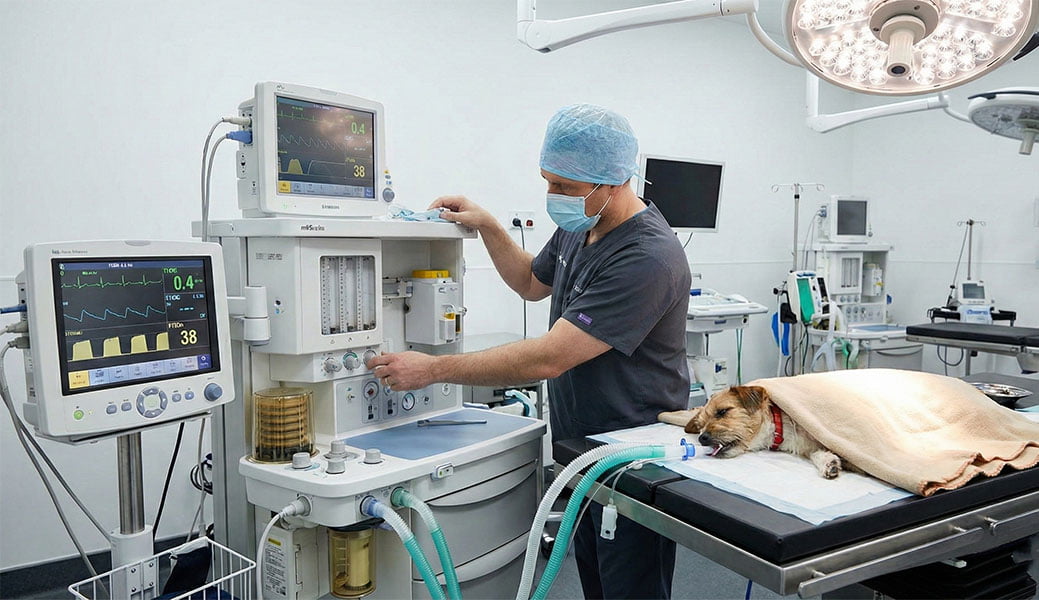
I remember a client who wanted to save money. They bought a compact machine for their clinic, even though they sometimes treated large dogs. It ended up being a costly lesson in matching equipment to needs. To avoid that situation, it's crucial to understand what each type of machine truly offers. Let's look closer at the specific differences.
What Are the Key Differences Between Compact and Full Workstation Anesthesia Machines?
Are "compact" and "workstation" just marketing terms? Not knowing the difference can lead to buying a machine that hinders your work. Let's clarify their distinct features and functions.
Compact machines are smaller, portable, and ideal for basic procedures on small animals. Full workstations are larger, integrated systems with built-in ventilators, advanced monitoring, and multiple gas options. They are designed for a wider range of animal sizes and complex, long-duration surgeries.
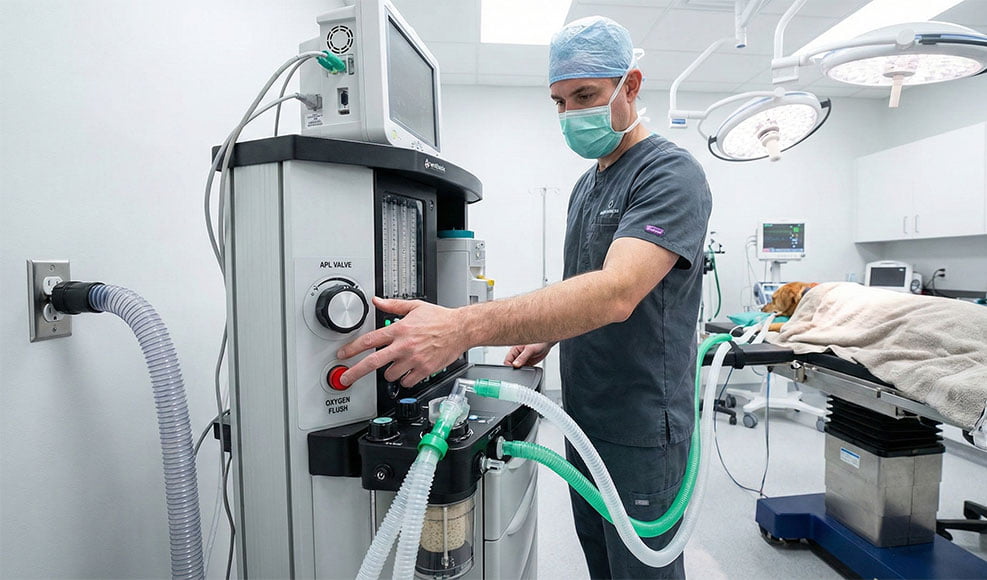
The choice between a compact machine and a full workstation goes beyond just size. It's about functionality, integration, and even the manufacturing philosophy. A compact unit is designed for simplicity and mobility. Think of it as a specialized tool for a specific job: safe, effective anesthesia for routine procedures in smaller patients. At OliveVet, even our compact machines are built with precision, using medical-grade materials to ensure reliability. A full workstation, on the other hand, is a comprehensive command center. It integrates multiple functions into one stable platform. This not only saves space in the long run but also streamlines your workflow during critical moments. Instead of managing separate devices, everything is right there.
Core Functionality Breakdown
The construction itself tells a story. Workstations often feature more robust frames and components designed for 24/7 hospital use.
- Compact Machines: Focus on delivering anesthetic gas safely. They are excellent for spays, neuters, and dental work in cats and small dogs. Their design prioritizes ease of use and quick setup.
- Full Workstations: Provide a complete life-support system. They include integrated ventilators, multi-parameter monitors, and sometimes even infusion pumps. The integration is key, as all components are designed and tested to work together seamlessly.
Feature Comparison Table
| Feature | Compact Anesthesia Machine | Full Anesthesia Workstation |
|---|---|---|
| Primary Use | Routine procedures, small animals | Complex surgeries, diverse patients |
| Ventilator | Usually separate or not included | Integrated, with advanced modes |
| Monitoring | Basic or requires separate monitors | Integrated multi-parameter monitor |
| Gas Options | Typically one vaporizer | Can support two vaporizers (e.g., Iso/Sevo) |
| Construction | Lighter materials, designed for mobility | Heavy-duty frame, medical-grade steel |
| Cost | Lower initial investment | Higher initial investment |
This structured comparison helps clarify that you are not just buying a machine, but an entire workflow solution designed for a specific level of care.
How Do You Choose the Right Anesthesia Machine for Your Veterinary Practice?
Ready to buy a new machine but worried about making a costly mistake? The wrong choice can limit your clinic's capabilities. Let's use a simple checklist to ensure success.
Assess your primary patient load (size and species), the types of surgeries you perform, your physical space, and your budget. Also, consider your future growth plans. A clinic planning to expand its surgical services might need a workstation, even if a compact machine fits today's needs.
Making the right choice is a strategic decision for your clinic's future. It's not just about today's needs. As a manufacturer providing one-stop solutions, I've seen clinics outgrow their equipment too quickly. You should think about your practice in three to five years. Start by analyzing your current and future needs with these key questions.
1. What is your patient demographic?
Do you exclusively treat cats and small dogs under 20kg? A compact machine might be perfect. Or do you see a mix of patients, including large breeds or exotics? A full workstation with a powerful, integrated ventilator offers the flexibility you'll need. Our workstations, for example, have ventilation modes specifically designed for a wide range of patient weights, ensuring safety for everyone.
2. What is the scope of your surgical procedures?
If your work is mostly routine, a reliable compact machine is efficient. However, for complex orthopedic, thoracic, or neurological surgeries, a workstation is non-negotiable. Its integrated monitoring and ventilation provide a higher level of support. This is where our ISO 13485 quality system1 shines; every component is built for high-stakes, long-duration performance.
3. What are your long-term goals and support needs?
Consider where you want your practice to be. If you plan to hire a specialist or take on more advanced cases, investing in a workstation is a smart move. It also signifies a deeper partnership with your supplier. With a full workstation, you're not just buying a product; you're getting a complete solution. This includes customized setups, training, and long-term service, which is a core part of our business model for our distributor and clinic partners.
Can a Compact Machine Handle the Same Procedures as a Full Workstation?
Can a compact machine do it all? Trying to stretch its capabilities to save money might seem smart. But it can put your patients at risk during complex surgeries.
No, a compact machine cannot safely or effectively handle all the same procedures as a full workstation. It lacks the integrated ventilation, advanced monitoring, and gas flow precision required for long, complex surgeries or for very large or very small patients who need precise respiratory support.
This question gets to the heart of patient safety. While a compact machine is excellent at its job, its job is not the same as a workstation's. The story I mentioned earlier is a perfect example. The client's compact machine couldn't provide adequate, stable ventilation for a large dog. They struggled to maintain the correct anesthetic depth, which put the patient at risk and damaged their clinic's reputation. This is because workstations are built for these exact scenarios.
Critical System: The Ventilator
A workstation's integrated ventilator is a game-changer. It's not just an add-on; it's part of the system's core design, tested for a 35% increase in ventilation stability.
- Precision & Advanced Modes: It delivers precise tidal volumes and offers advanced modes like PEEP (Positive End-Expiratory Pressure). PEEP is crucial in thoracic surgery to prevent lung collapse. A compact machine simply doesn't have this capability.
- Safety Alarms: Integrated systems have sophisticated alarms that alert you to pressure changes, volume discrepancies, or apnea. These are life-saving features that are less robust or absent when you pair a basic machine with a separate ventilator.
Integrated Monitoring & Workflow
Workstations display all vital signs—ECG,2 SpO23, EtCO24, temperature—on one screen. Our monitors achieve 99.5% accuracy. This provides a complete, real-time picture, allowing for faster decisions. Patching together separate monitors with a compact machine creates a cluttered workspace and "alarm fatigue," where important alerts can be missed. The seamless workflow of a workstation reduces human error and allows your team to focus entirely on the patient, not the equipment. The risk is simply not worth the perceived savings.
Conclusion
Choosing the right anesthesia machine is an investment in patient safety and clinic efficiency. Match the machine to your patient load, surgical scope, and future goals for long-term success.
Understanding ISO 13485 ensures your anesthesia machine meets high safety and quality standards, crucial for patient safety and clinic reliability. ↩
Understanding ECG monitoring is crucial for ensuring patient safety during surgeries, as it provides real-time heart activity data essential for decision-making. ↩
Understanding SpO2 monitoring is crucial for ensuring patient safety during surgeries, as it provides real-time data on oxygen saturation levels. ↩
Understanding EtCO2 monitoring is crucial for ensuring precise respiratory support during surgeries, enhancing patient safety and surgical outcomes. ↩