
 Every clinic owner battles the same dilemma: balancing the budget while ensuring patient safety. You see a refurbished veterinary vital signs monitor for half the price of a new one, and it feels like a smart financial win. But is it really?
Buying new veterinary patient monitors is safer and more cost-effective long-term than buying used. New units provide full manufacturer warranties, reliable sensors for low-perfusion patients, and compatibility with modern practice software. Refurbished units often hide failing batteries, degraded sensors, and lack the support needed when equipment fails during a critical surgery.
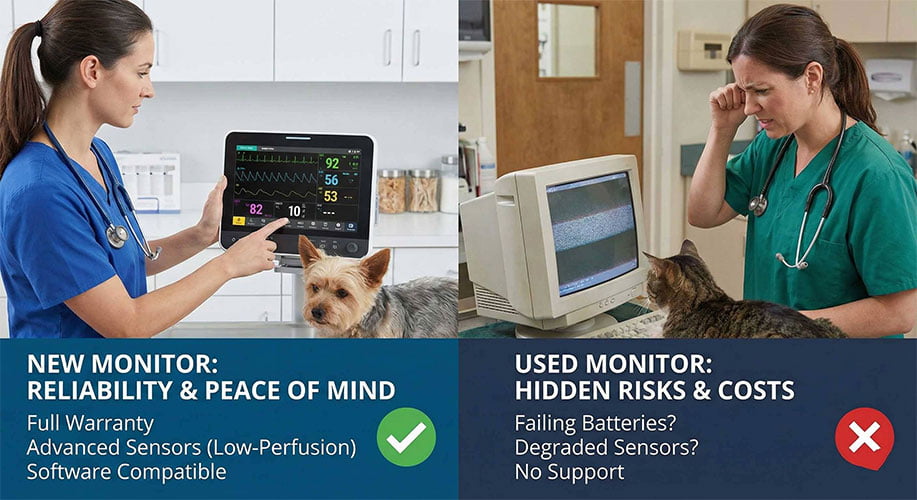
I have spoken with hundreds of vets who learned this lesson the hard way. One clinic manager told me about a used monitor that failed right in the middle of a complex orthopedic surgery. The screen just went black. They had no backup. That single incident cost them more in stress and reputation than the money they "saved" on the device. In this guide, we will break down why investing in new vet monitoring equipment is the only responsible choice for 2026.
What Are the Hidden Risks of Refurbished Veterinary Equipment?
We all love a bargain, but medical electronics degrade in ways you cannot always see. Do you know the true history of that used device?
Refurbished equipment often suffers from invisible wear and tear, particularly in power supplies and internal sensors. Without a verifiable service history, you risk sudden failure. A new animal patient monitor guarantees factory-calibrated accuracy and eliminates the gamble of inheriting someone else’s technical problems.
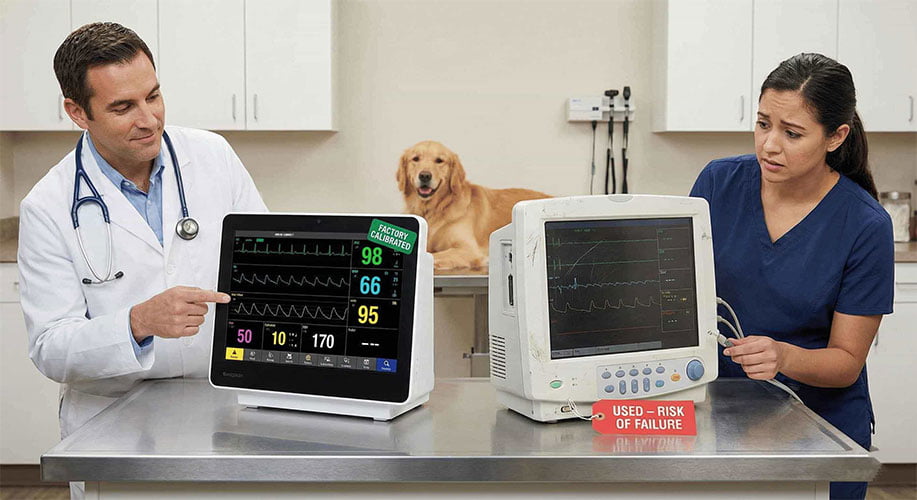
Let's look closer at what actually happens inside these machines. When you buy a used car, you can check the mileage. When you buy a used animal patient monitor, the "odometer" is much harder to read.
Refurbished units are often just cleaned up on the outside. The internal components, specifically the electrolytic capacitors on the power board, have a finite lifespan. They dry out over time. A monitor might turn on fine today, but if those capacitors are 80% depleted, they will fail within months.
Here is a breakdown of the risks you take with used gear versus the security of new Olivevet models:
| Component | Risk with Used/Refurbished | Benefit of New (2026 Models) |
|---|---|---|
| Batteries | Often old cells with reduced capacity. May last 20 minutes instead of 4 hours. | Brand new Lithium-ion cells guaranteeing 4+ hours of backup power. |
| SpO2 Sensors | Clips are fragile. Used sensors often have micro-fractures in the cable, leading to intermittent signal loss. | Factory-fresh sensors with reinforced cabling and sensitive optics. |
| Screen/Display | Backlights dim over time. Old LCDs can be hard to read in bright operating rooms. | High-resolution LED screens with superior brightness and contrast. |
| Software | Outdated firmware that may not integrate with 2026 electronic records systems. | Latest firmware with USB/WiFi data export capabilities. |
I always tell my clients: you are not just buying a box; you are buying the assurance that the heartbeat on the screen is real. With used gear, that assurance is always compromised.
How Does the Cost of Ownership Compare?
The sticker price is lower for used gear, but does that mean it costs less?
While the upfront cost of a new monitor is higher, the total cost of ownership is often lower due to warranties and longevity. Used equipment frequently requires expensive out-of-pocket repairs within the first year, whereas new Best Veterinary Monitors 2026 come with multi-year protection and zero maintenance costs.
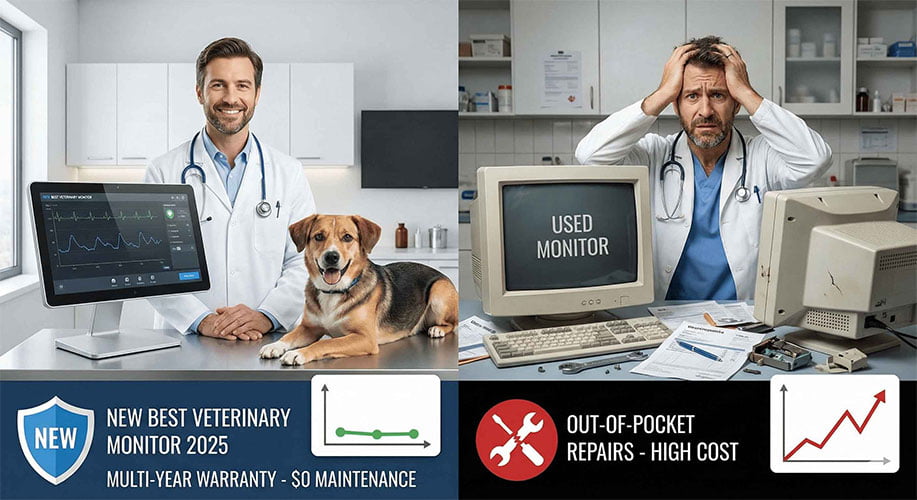
Let's do the math. I want to approach this like a business owner. You buy a refurbished unit for $800. It comes with a 90-day warranty (if you are lucky). Seven months later, the SpO2 module fails. Since it is out of warranty, you have to ship it to a third-party repair shop.
- Shipping costs: $50
- Diagnostic fee: $100
- Part replacement: $300
- Downtime cost: You are down a monitor for 2 weeks, limiting your surgical capacity.
Now you have spent $1,250, and you still have an old machine.
In contrast, a new Olivevet VET-M12 might cost you slightly more upfront, but it gives you peace of mind for years.
- Warranty: We cover parts and labor. If something breaks, we fix it or replace it.
- Tax Benefits: In many regions, buying new capital equipment allows for Section 179 tax deductions (in the US) or similar write-offs that apply differently to new vs. used goods.
- Resale Value: A 5-year-old monitor you bought new still has resale value. A 10-year-old monitor you bought used is essentially e-waste.
When we talk about the Best Veterinary Monitors 2026, we are talking about value, not just price. The "cheap" option is usually the most expensive one in the long run.
Why Does 2026 Technology Matter for Patient Safety?
Is a 5-year-old monitor really that different from a modern one?
Yes, modern veterinary vital signs monitors utilize advanced algorithms specifically designed for animals, not adapted from humans. New 2026 technology offers superior performance in low-perfusion situations, such as with small kittens or animals under deep anesthesia, which older units often fail to detect.
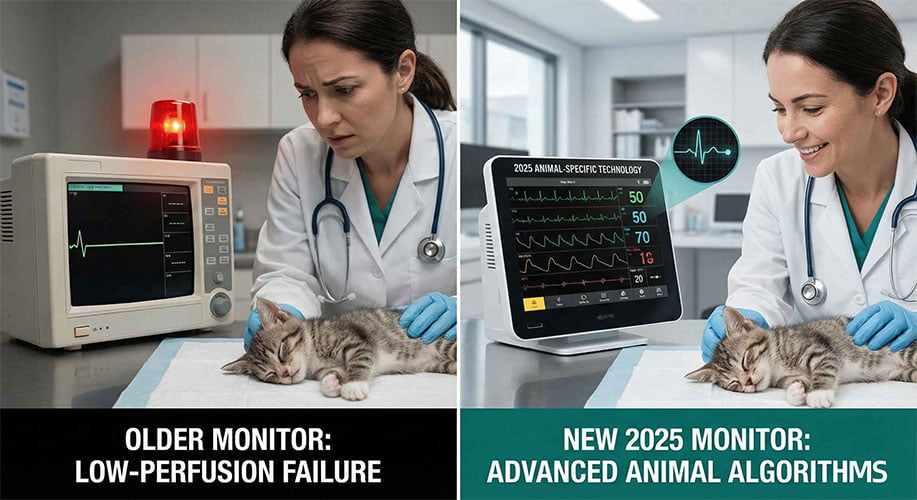
This is the most critical point for me. The technology inside veterinary monitoring equipment has advanced massively in the last three years.
Older, used monitors often use generic algorithms. They struggle significantly with two things:
- Motion Artifacts: If a dog shivers waking up from anesthesia, old monitors scream false alarms.
- Low Perfusion: When blood pressure drops or the patient is very small (like a kitten or exotic pet), the pulse signal is weak.
I have seen vets using older refurbished units get frustrated because the SpO2 keeps beeping "Probe Off" or reading 85% when the patient is actually fine (or vice versa). This leads to "alarm fatigue." You start ignoring the beeps because they are usually wrong. That is dangerous.
Newer models, like our Olivevet Handheld Series, use updated digital signal processing. We filter out the noise. We can pick up a pulse on a vasoconstricted cat that an older unit would miss entirely.
Key 2026 Tech Advancements:
- NIBP: New monitors often integrate gold-standard blood pressure technology that is faster and gentler on the animal.
- Connectivity: New units have HDMI outs for large screens for sending reports directly to your laptop. Used units usually rely on obsolete serial ports.
- User Interface: Modern touchscreens are intuitive, like your phone. Old units require navigating clunky menus with a spin-wheel, wasting time during emergencies.
Conclusion
We strongly recommend prioritizing new equipment for your critical care needs. The initial savings of buying used are quickly erased by repair costs, safety risks, and the lack of modern features.
At Olivevet, we control our manufacturing process from start to finish. We don't just assemble parts; we engineer reliability. When you choose a new Olivevet monitor, you aren't just getting a device; you get a partner dedicated to keeping your patients safe and your clinic running without interruption. Don't gamble with your patient's vitals—invest in certainty.